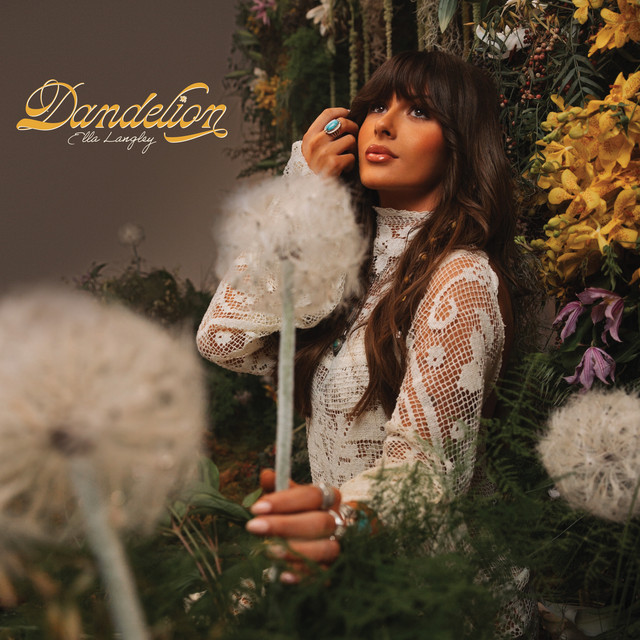
Dandelion – Ella Langley
Artist: Ella Langley | Label: SAWGOD/Columbia Records | Released: 10 April 2026 | Rating: 6/10
There’s a particular kind of pressure that comes with a breakthrough single. When “Choosin’ Texas” made Ella Langley the first female artist to simultaneously top the Billboard Hot 100, Hot Country Songs, and Country Airplay charts, the clock started ticking on what she’d do next. Dandelion, her second album and follow-up to Hungover, is her answer — and it’s a thoughtful one, even if it occasionally mistakes mood for momentum.
The record opens with “Froggy Went a Courtin’ – Intro,” a solo rendition of the old folk standard she used to sing with her grandfather, and it’s a disarming move. No fanfare, no attempt to capitalise on the crossover moment that preceded it. Just a voice and a melody passed down through generations. It sets the album’s central preoccupation clearly: roots, memory, and the question of what survives when you start to grow. The fact that it bookends the album — a mirrored outro closes things out — suggests Langley wanted Dandelion to feel like a complete thought rather than a collection of songs. Whether she quite pulls that off is another matter.
What she has pulled off is a production that genuinely flatters her. Working alongside Miranda Lambert and Ben West, Langley has built a record where the atmosphere is precise and deliberate. Spencer Cullum’s pedal steel bleeds through the mix on tracks like “Low Lights” and “Loving Life Again” like something half-remembered, while Tom Bukovac’s electric guitar adds just enough grit to prevent the whole thing drifting into something too polished to feel real. Lambert told Rolling Stone she wanted to “honor [Langley’s] vision every step of the way,” and that restraint shows — this doesn’t sound like a Lambert record, it sounds like what Langley might become.
“This record has so much growth in it. I’ve never poured more of myself into a project, into a song, into an idea.”
The trouble is that Dandelion occasionally proves its own point a little too literally. Growth-as-theme is fine. Growth-as-every-lyrical-beat-for-sixteen-tracks gets wearing. The seasonal imagery — new buds, blooming, renewal — recurs so frequently across the middle stretch that by the time “Butterfly Season” arrives, the metaphor has been pressed flat. It’s a shame, because that closing duet with Lambert is genuinely lovely, the two voices trading lines with the kind of easy chemistry that can’t be manufactured in a mixing session. But it arrives slightly worn-down by what surrounds it.
The title track itself, which Langley has said she nearly put on Hungover before holding back, is worth the wait. There’s something in its construction — the way the chorus opens outward rather than slamming shut, the way Charlie Worsham’s mandolin keeps the whole thing from settling too comfortably — that feels properly earned. The dandelion-as-hangover-remedy detail isn’t just a cute bit of album sequencing; it means the title track carries actual weight as a bridge between records, a breath taken before moving forward.
“Choosin’ Texas” still sounds like a radio moment, and there’s nothing wrong with that. It’s the kind of song Kacey Musgraves used to make when she was still allowed on country radio — melodically generous, lyrically pointed, not above a hook. That Langley landed it at the top of three charts simultaneously says something about timing and taste converging at once. Placed third in the tracklist, after the folk intro and the title track, it serves as a reminder of just how commercially acute Langley can be when she lets herself. The rest of Dandelion, to its credit, largely resists that pull.
“Be Her” is the album’s most interesting moment outside the obvious singles. Langley’s vocal sits just slightly forward in the mix, unguarded in a way that suits the lyric’s subject — the version of yourself you left behind, or the one you’re still trying to become, it’s deliberately ambiguous — and the production drops to almost nothing underneath her. It’s the kind of track that would sound extraordinary live, which is both a compliment and a mild criticism: it feels like it’s waiting for a room, rather than thriving where it is.
The back half of the record is where Dandelion loses a bit of altitude. “Speaking Terms,” “I Gotta Quit,” and “Bottom Of Your Boots” are all perfectly competent, the sort of country-adjacent material that would sound fine embedded in a playlist but demands less of your attention than Langley is capable of commanding. “Last Call For Us” recovers some ground — there’s a weariness in the vocal that the production matches, the strings arriving late and doing exactly what strings should do — but by the time the album reaches its close with “I Can’t Love You Anymore,” you’re aware that Dandelion is longer than it needs to be at nineteen tracks, including the interludes.
For a record so focused on the idea of identity — who Langley is, where she came from, who she wants to be — it’s curious that the edges sometimes feel blurred rather than clarified. The ambition here is real, and so is the talent. But ambition and a clear sense of direction aren’t always the same thing, and Dandelion occasionally feels like it’s reaching in several directions simultaneously, hoping one of them turns out to be forward. Compare this to how Wolf Alice handled a similar moment of consolidation on The Clearing, or the sheer focused intent of Olivia Dean’s Messy, and you start to feel the difference between an artist who knows exactly what they’re making and one who’s still, bravely, working it out.
Dandelion is not the definitive statement of who Ella Langley is. But it might be the necessary one — the record you have to make before you make the record that matters.