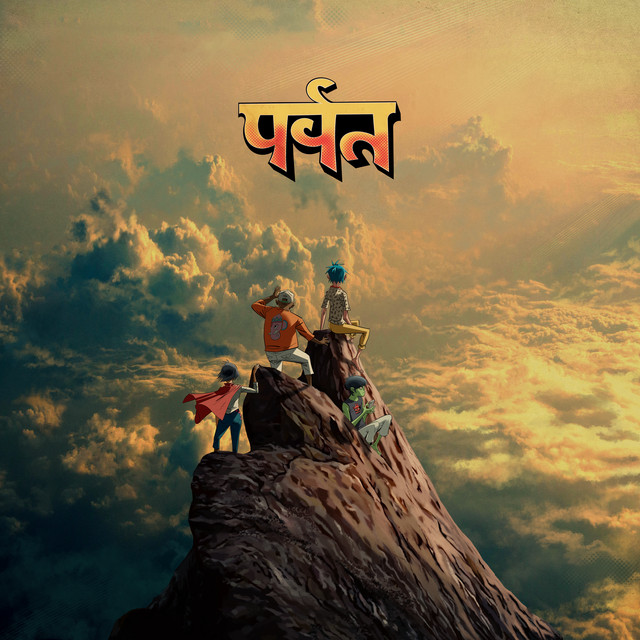
The Mountain — Gorillaz
Gorillaz · The Mountain · 2026 · 8/10
There’s a particular kind of Gorillaz album that arrives not with a bang but with a slow, disorientating pull — the sort that takes three listens before you realise it’s already moved into your head permanently. The Mountain is that kind of record. It doesn’t announce itself like Humanz did, all maximal chaos and celebrity pile-ons. It doesn’t coast on the stripped-back intimacy of The Now Now. What it does instead is something stranger and, ultimately, more rewarding: it builds a world out of contradictions, stitching together sitar drones, post-punk spite, Colombian trap, and spectral soul into something that feels, against all odds, coherent.
The album’s structural gamble is obvious from the first thirty seconds. The title track opens with Anoushka Shankar’s sitar winding around a beat that takes its time arriving, Dennis Hopper’s posthumously assembled vocal fragments floating above it like something half-remembered. It’s an audacious move — opening a pop record with a six-minute slow burn that refuses to resolve neatly — but Damon Albarn has always trusted the audience to meet him where he is. Here, the meeting point is worth the walk.
The Moon Cave is where the album first reveals the full breadth of its ambitions. Bobby Womack’s voice (another posthumous contribution, presumably culled from archival sessions) sits alongside Black Thought’s rapid, meticulous bars and Asha Puthli’s spectral high register, all three orbiting each other without colliding. It shouldn’t work. It emphatically does. Dave Jolicoeur’s presence — itself a reminder of how long Gorillaz have been in conversation with hip-hop’s most interesting corners — gives the track an additional emotional weight that’s hard to shake once you’ve noticed it.
“The empty dream machine keeps running / someone left it on”
That line from The Empty Dream Machine, delivered over Johnny Marr’s typically pristine guitar work and Black Thought’s controlled intensity, is the album in miniature: mechanised, melancholy, oddly beautiful. Marr’s contribution across The Mountain deserves specific mention — he appears on four tracks and never repeats himself, moving from the jangling, almost Smiths-adjacent lines on The Plastic Guru to something far more textured and unsettled on The Sweet Prince, where his playing coils around Anoushka Shankar’s strings in a way that feels genuinely new for both of them.
If there’s a centre of gravity, it might be The God of Lying, the collaboration with IDLES that arrives mid-album like a bucket of cold water. Joe Talbot’s vocal delivery — all confrontational earnestness — cuts against Albarn’s characteristic world-weariness in ways that generate real friction. It’s the album’s most overtly political moment, and the least subtle, but subtlety was never really the point here. Sometimes a track just needs to be loud about what it is.
The record does stumble occasionally. The Manifesto, featuring Trueno and the late Proof, is the most conventional hip-hop moment on the album and the least interesting — it feels like a track that could have appeared on almost any Gorillaz project from the past decade, and the contrast with the surrounding material’s ambition makes it feel more placeholder than contribution. Orange County, despite the intriguing Bizarrap and Kara Jackson combination, takes too long to build to a payoff that never quite justifies the patience required.
But these are detours, not failures. And the album recovers quickly. Damascus, with Omar Souleyman’s hyperkinetic dabke rhythms crashing into Yasiin Bey’s measured, philosophical flow, is one of the year’s best three minutes — watch it land live and you’ll understand immediately why this record is generating the kind of excitement that most Gorillaz projects take a few years to accumulate. Casablanca, closing the album’s penultimate stretch with Paul Simonon and Johnny Marr together in what sounds like a deserted Mediterranean bar at 3am, is genuinely moving in the way that only Albarn’s best melancholy manages to be — specific without being confessional, nostalgic without being indulgent.
Delirium deserves its own paragraph. The Mark E. Smith collaboration — again, archival; Smith died in 2018 — is either an act of inspired curation or a slightly uncomfortable act of posthumous conscription, depending on your tolerance for such things. We lean towards the former. Smith’s voice, all ragged authority, sits over a beat that feels genuinely unsettled, and the result sounds like nothing else on the record. It’s a reminder that Gorillaz at their most interesting are always in conversation with the dead — musical traditions, lost collaborators, earlier versions of themselves.
The closest comparison point might be Plastic Beach, another record that tried to make sense of chaos through discipline, though The Mountain is less interested in thesis statements. Where Plastic Beach had an ecological anxiety at its centre that shaped everything around it, The Mountain is more diffuse — more interested in the texture of its questions than in arriving at answers. That’s not a weakness. It’s a temperament.
Anoushka Shankar’s presence as the album’s most consistent thread is the choice that holds it all together. Her contributions appear on five tracks and function less as a feature than as a structural element — the drone beneath the noise, the through-line that makes a fifteen-track, twenty-guest record feel like a single sustained thought rather than a compilation. Her own catalogue has always occupied a space between tradition and experiment; here, she finds a partner who understands that space intuitively.
The Mountain is not a perfect record. It is, however, a genuinely surprising one — and in 2026, from a band twenty-six years into their career, that counts for considerably more.