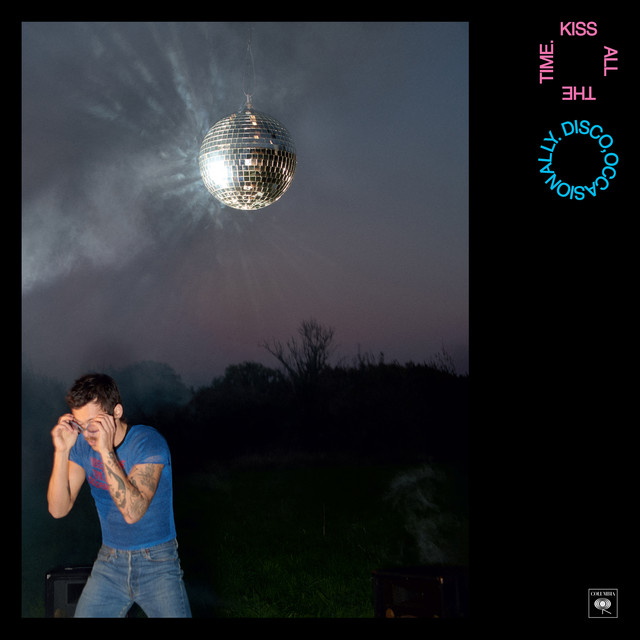
Kiss All The Time. Disco, Occasionally. — Harry Styles
Harry Styles | Kiss All The Time. Disco, Occasionally. | Erskine / Columbia Records | 8/10
There’s a version of this album that doesn’t exist — the cautious one, the one where Harry Styles plays it safe, consolidates the Fleetwood Mac-adjacent warmth of Harry’s House, and delivers another twelve tracks of breezy, radio-friendly pop that everyone likes and nobody loves. Thankfully, Kiss All The Time. Disco, Occasionally. is not that album. This is the record of a man who has looked at his own comfort zone and decided to set fire to it, then dance in the smoke.
Produced once again by Kid Harpoon and Tyler Johnson — the pairing responsible for some of the finest moments across his last two records — this fourth album was recorded across 2024 and 2025 and arrives sounding like it needed every one of those months. The flashes of ’70s guitar and ’80s hooks that lit up earlier Styles material have been pushed further here, deeper into the territory of electronic house, post-punk, and — yes — full-throated disco. It’s a record that trusts its own instincts, which makes it both the most exciting thing Styles has released and, occasionally, the most frustrating.
Let’s start where the album demands you start: “Aperture,” the lead single, the statement of intent, the five-minute argument for why Harry Styles should never again be dismissed as a pop confection. It topped the Billboard Hot 100 — which is the kind of thing that happens to songs that shouldn’t by rights be that big, songs with actual ambition. It sprawls, it builds, it earns every one of its three hundred seconds. There’s a section about two-thirds in where the production drops almost entirely away and Styles sounds genuinely, unguardedly uncertain, like a man asking a question he doesn’t know the answer to. It’s the best thing he’s ever recorded. We’ll say it plainly.
“I stopped waiting for the door to open — I took the walls down instead.”
“The Waiting Game” is the album’s strangest and most rewarding detour — digitised strings braided around acoustic guitar, the whole thing conjuring that specific feeling of a dream you can almost but not quite remember. It’s unsettling in the best way, sitting mid-album like a deliberate disruption of momentum, and it works precisely because Styles and his producers resist the urge to resolve it into something comfortable.
“Taste Back,” meanwhile, is the record’s most immediately loveable moment. A dreamy, apprehensive song about reconnecting with an old lover — Paris is name-dropped, day drinking is implied — it features backing vocals from Wolf Alice’s Ellie Rowsell, and the pairing is inspired. Rowsell’s voice adds an edge of melancholy that Styles’ own more polished tone can’t quite supply on its own. It’s a delicious collision of lust and longing, the kind of track that sounds better at 2am than it does in the cold light of a review.
The album’s themes — romantic grief, restlessness, the tension between what you want and what the world expects of you — are nothing new for Styles, but they’re worn more lightly here. In the liner notes he thanks “those who inspire me to make anything,” which is either very sweet or very vague, depending on your disposition. The recurring idea that nightclubs hold genuine transformative power sounds like it could tip into naivety, but the production gives it enough grit that it never quite does. “Dance No More” is the record’s actual disco moment, and it earns its place — propulsive, generous, the kind of track that Charli XCX would nod at approvingly.
Where the album occasionally stumbles is in its middle third. “Season 2 Weight Loss” is intriguing as a title and frustratingly underwritten as a song — it gestures at something interesting about self-image and reinvention without quite landing the punch. “Pop” is clever in theory, a meta-commentary on the genre Styles is simultaneously working within and pushing against, but it risks being too knowing for its own good, the kind of track that sounds like it’s winking at you from across the room.
“Coming Up Roses” rescues the back half entirely. A ballad written by Styles alone, it opens with soft piano and strings before Styles’ vocals carry the weight of the whole thing — romantic uncertainty rendered with a specificity that earns its emotional heft. It’s the kind of song that reminds you why the best pop music remains a fundamentally generous art form.
For context, this is an artist who arrived in this era having already shown real range — and the question hovering over this record was always whether he’d push further or consolidate. Compare the confidence here to something like Lorde’s recent arena run, or the uncompromising self-definition on Jade’s That’s Showbiz, Baby — The Encore, and you start to see where Styles sits: an artist who arrived at boldness a little later than some, but has arrived nonetheless. The album’s title, apparently a life mantra, initially sounds like the kind of thing that gets embroidered on a cushion. By the time “Carla’s Song” closes things out — quietly, without fanfare, just voice and texture — it sounds like a genuinely held belief.
Kiss All The Time. Disco, Occasionally. is not a perfect album, but it’s a thrillingly imperfect one, and right now that feels worth considerably more.