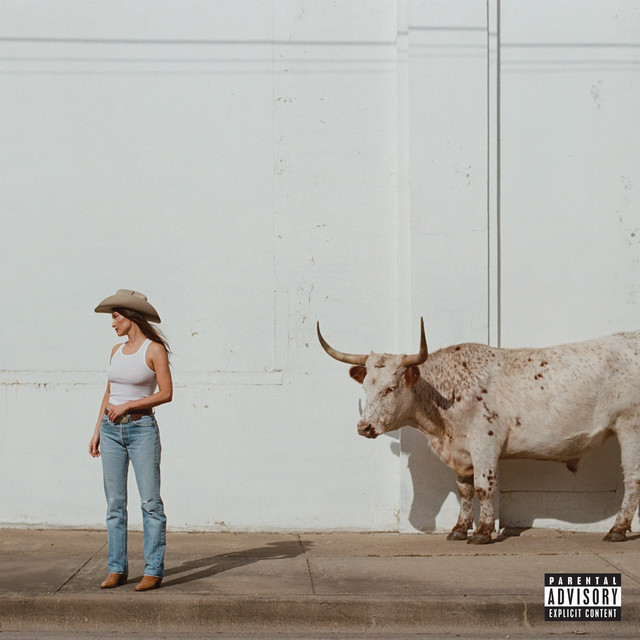
Middle of Nowhere — Kacey Musgraves
Lost Highway Records · 8/10
There’s a sign in Kacey Musgraves’ hometown of Golden, Texas that reads “Golden: Somewhere in the Middle of Nowhere.” It’s the kind of thing you drive past without registering, until suddenly it says everything. That’s precisely the quality Musgraves has bottled on her seventh studio album — the meaning that accumulates quietly, in places you’d dismissed.
Middle of Nowhere arrives as Musgraves’ most geographically and emotionally rooted record, and also her most straightforwardly country one. If Golden Hour made her a crossover darling and star-crossed leaned into theatrical grief, this is the album where she strips most of that cosmopolitan ambition away and replaces it with pedal steel, mandolin, and a deliberate, unhurried drawl. The context matters: she spent a period of prolonged singlehood revisiting Golden’s dirt roads, and that dust genuinely settles on everything here. This isn’t a concept album, exactly, but it has a unifying emotional logic — solitude not as wound but as chosen territory.
And what a place to plant your flag. The title track opens proceedings with aching patience, its melody unwinding like a two-lane highway at dusk. It’s country in the most traditional sense — not Nashville sheen but something older and rawer, built around what isn’t there as much as what is. Paul Franklin’s steel guitar, which appears across multiple tracks, is worth the price of admission alone. His playing on Abilene in particular has the kind of unhurried grace that most contemporary country records don’t even bother reaching for anymore.
“I became so at ease with being in the ‘middle of nowhere’ in many senses and sitting in the un-comfort of the undefined.”
That comfort with ambiguity — the refusal to resolve things tidily — is what elevates the album above what could easily have been a navel-gazing retreat record. Back on the Wagon is a masterclass in denial rendered as confection: a gently lilting number that, if you half-listen, sounds like contentment, but sits considerably darker once you lean in. Uncertain, TX, featuring Willie Nelson — a collaboration that sounds less like a career highlight moment and more like two people who simply understand each other — is the album’s most visceral track, Musgraves uncharacteristically furious, Nelson’s weathered presence lending the whole thing a kind of legitimacy that can’t be manufactured. It genuinely crackles.
The collaborations are handled with more care than most records bother with. Horses and Divorces with Miranda Lambert doesn’t feel like a PR-approved country queens pairing; it feels like two writers who’ve both made albums about ending marriages sitting down and finding exactly the right joke about it. Coyote with Gregory Alan Isakov is more delicate — a slow-burning reluctance to fall again, the kind of song where the hesitation is the whole point. Isakov’s fingerpicked folk sensibility and Musgraves’ Tennessee Williams by way of Texas lyricism turn out to be a genuinely unexpected fit.
Where the album wobbles is in its midsection. Loneliest Girl and Rhinestoned are both fine songs that would thrive on a different record but feel slightly adrift here, their gloss sitting uneasily against the more stripped-back material surrounding them. It’s not that they’re bad — Musgraves is too consistent a writer for that — but they suggest a record that occasionally lost its nerve about how bare it wanted to be. The bonus tracks Musgraves surprise-dropped after release don’t entirely address that imbalance either, though they have their pleasures.
Everybody Wants to Be a Cowboy with Billy Strings is exactly as enjoyable as it sounds — a bluegrass-inflected romp that’s the album’s most purely fun moment — and Mexico Honey, with its Norteño flourishes and mariachi undertow, is evidence that Musgraves’ ear for regional Mexican music, first hinted at on earlier records, is now something she can deploy with real authority rather than as texture. It’s a genuinely lovely song, and one of the few moments where the pared-back ethos makes room for something approaching exuberance.
Hell On Me closes the record, and it’s the correct choice — patient, unresolved, ending on an image rather than a conclusion. It doesn’t offer catharsis, which in a lesser record would be a problem, but here feels honest. Musgraves isn’t wrapping anything up. She’s still in the middle of nowhere, and she’s made her peace with that.
This is, by any measure, a confident, well-crafted album from an artist in full command of her abilities. It won’t convert anyone who finds traditional country a barrier — those who felt at home with Golden Hour’s cosmic pop shimmer might find its relative austerity a mild adjustment — but as a document of what Musgraves sounds like when she stops reaching outward and starts listening to what’s immediately around her, it’s quietly remarkable. Compare it to the direction someone like Olivia Rodrigo is currently pulling pop in, and the contrast couldn’t be sharper: this is an artist deliberately refusing to be swept along.
Middle of Nowhere isn’t her best record, but it might be her most herself — and right now, that’s the more interesting thing to be.