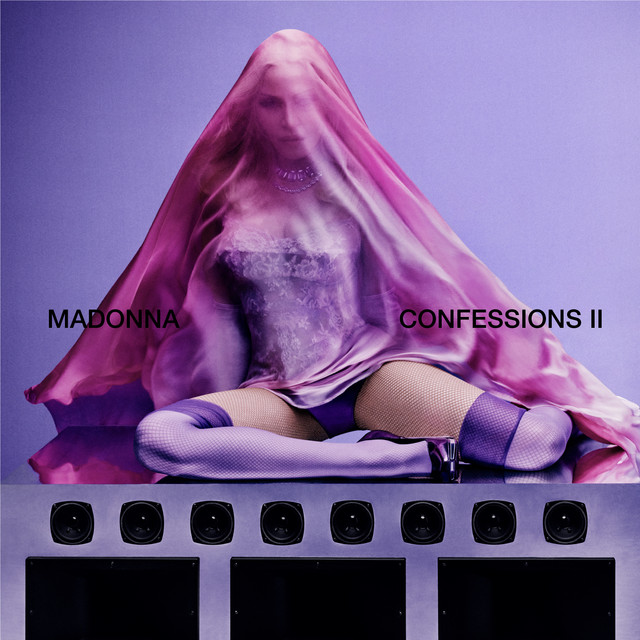
CONFESSIONS II — Madonna
Rating: 5/10
There’s a version of CONFESSIONS II that works magnificently. You can hear it in the opening minute of “I Feel So Free,” where a four-to-the-floor kick drum announces itself with the confidence of someone who knows they’ve been missed, and for a moment the question of whether Madonna still has it dissolves entirely. The question is whether that feeling sustains. It doesn’t — not reliably, not across 63 minutes, and not when the album’s emotional ambitions keep outrunning its ability to actually land them.
Let’s be clear about the context. Seven years is a long silence for someone who once treated album cycles like sprints. Confessions on a Dance Floor in 2005 was a genuine landmark — a seamless, 51-minute argument for why Madonna remained the most instinctively intelligent pop architect of her generation. Sequelling it two decades later is either a bold act of self-belief or a colossal gamble. CONFESSIONS II is, frustratingly, both.
The production deserves its praise. Where the original lived in Stuart Price’s pristine disco-house, this record burrows deeper — Detroit and Chicago house textures, a French Touch shimmer on “Danceteria” that nods to Daft Punk without embarrassing itself, and a structural discipline that avoids the gargantuan drops clogging up most contemporary dance music. “Love Sensation” is a genuine high point: the synths stack in patient, controlled waves, and Madonna sounds genuinely at ease inside the track rather than performing ease from a distance. “Bring Your Love” runs a similar trick, its groove deliberately unhurried, giving the lyrics — which circle grief and estrangement — room to breathe without suffocating the dancefloor instinct.
Then there’s “My Sins Are My Saviour,” the Stromae collaboration, which is the most interesting thing on the record precisely because it’s the most uncomfortable. The two of them circle each other warily over a fractured breakbeat, neither quite resolving into the other’s register, and that tension is productive in a way that too much of CONFESSIONS II isn’t.
“My sins are my saviour / My guilt is my grace / I built a cathedral / Out of my disgrace.”
That’s a striking lyric. The problem is the album keeps promising us cathedrals and delivering ante-rooms.
Paste Magazine noted the album “may lack a song as instantly iconic as ‘Hung Up,’” which is a diplomatically generous way of saying it lacks a song that does what “Hung Up” did — which was to announce its intentions in eight bars and never once waver. Nothing on CONFESSIONS II lands with that precision. “Read My Lips” comes closest, a brisk, trebly house track with a hook that lodges itself efficiently, but it peaks too early and coasts through its final two minutes. “Good For The Soul” tries for the same trick and loses the thread entirely by the bridge, resolving into a pleasantly forgettable middle section.
The back half is where the record’s ambitions and its execution diverge most sharply. The Consequence of Sound review — the sole dissenting voice in an otherwise wall-to-wall critical embrace — puts it plainly: the album “talks about transcendence instead of actually delivering it.” That’s exactly right, and nowhere is it more apparent than on “Fragile” and “The Test,” two tracks that reach for something genuinely affecting — grief processed through rhythm, spirituality worn without apology — but both settle for atmosphere over arrival. They’re not bad songs. They’re incomplete ones.
“School” is more difficult to defend. It’s the album’s most misguided moment: a trip-hop-adjacent detour that might have worked in a tighter context but here feels like a gap in the sequencing disguised as a tonal shift. Nia Archives demonstrated recently what you can do when you trust breakbeats to carry emotional weight rather than decorating them with explanatory lyrics. “School” doesn’t trust its own instincts enough.
Closer “L.E.S. Girl” is, by contrast, the record at its most relaxed and probably its most honest — a loose, reflective thing that doesn’t reach for a climax and is better for it. There’s a lineage here to Robyn’s capacity to hold contradictions inside pop frameworks, though Madonna arrives at the feeling by a different route.
Watch the video for “Love Sensation” here — it’s the clearest statement of what the album aspires to, and the gap between aspiration and execution is smaller there than almost anywhere else on the record.
The critical consensus around CONFESSIONS II — 82 on Metacritic, four stars from NME, 8.1 from Pitchfork — tells you something true: this is not a creative embarrassment, and compared to the decade of diminishing returns that preceded it, it genuinely does represent a recalibration. But critical relief is not the same as critical rigour, and there’s a generosity at work in that consensus that the album hasn’t entirely earned. “Genuinely vital” is doing a lot of lifting for a record whose vital signs flicker unpredictably across its second half.
Madonna at her best makes dance music that feels urgent even when it’s joyful, personal even when it’s enormous. CONFESSIONS II gets there intermittently, which is more than could be said for most of what she’s released this century — but intermittently, on an album this long and this ambitious in scope, is damning enough.