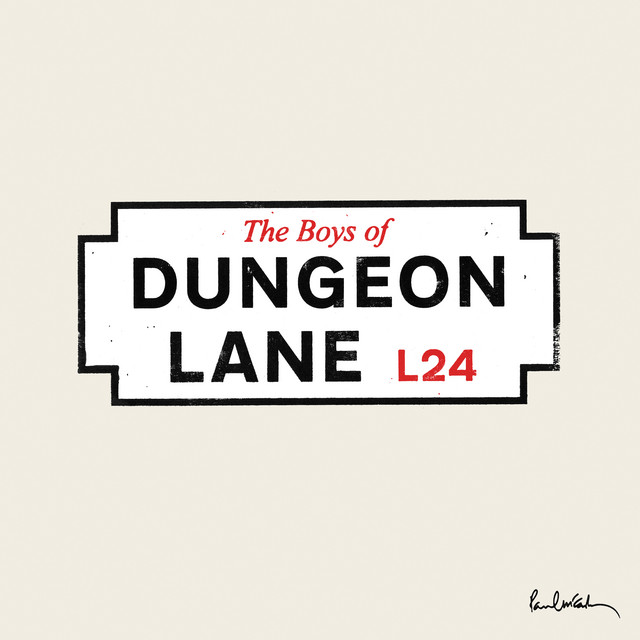
The Boys of Dungeon Lane
Paul McCartney — The Boys of Dungeon Lane (Capitol Records, 2026)
5/10
There’s a version of The Boys of Dungeon Lane that would have been one of the most emotionally devastating albums of Paul McCartney’s career. A man in his eighties, returning in memory to Dungeon Lane in post-war Speke, writing about a city still blinking the rubble out of its eyes, about parents who kept things together through sheer grit, about two kids called John and George who hadn’t yet become anything to anyone. The bones of that album are in here. They’re just buried under a lot of filler, a few frankly puzzling choices, and the kind of overproduction that makes you wish someone in the room had said “Paul, this is enough.”
Let’s start with what works, because it genuinely does work, in places, and with real force. Opener “As You Lie There” is a shock of electricity — McCartney letting his aged voice rip rather than coddle it, all rough edges and glee, the kind of raucous energy that makes you sit bolt upright and think right, he’s still got it. It’s the sound of someone who knows exactly what they’re doing and has decided, just this once, to stop being tasteful about it. If the rest of the album had followed that signal, we’d be talking about something special.
“Home to Us” is the other undeniable highlight, a jaunty duet with Ringo Starr that functions as a sort of love letter from two of the last remaining witnesses to a Liverpool that no longer physically exists. It doesn’t try to be profound. It’s two old men singing about their rough-and-tumble hometown with the easy warmth of people who don’t need to perform the sentiment because they actually feel it. It’s charming in the most unguarded sense of the word.
“The story before the story” — that’s the promise the album makes, and the problem is it can’t quite decide whether to keep it.
“Days We Left Behind,” which sits third in the tracklist and ought to be a centrepiece, gets closest to the album’s stated ambitions. McCartney writes about early adventures with Harrison and Lennon with the kind of specificity that lifts it above nostalgia-by-numbers — you sense real memory rather than myth-making, real boys rather than the icons they’d become. It’s genuinely moving, and his multi-instrumental approach (he plays over twenty instruments across the record) gives the track a homespun, intimate texture that producer Andrew Watt — who has form for coaxing late-career vitality out of rock veterans — mostly serves rather than smothers.
Mostly. Because Watt’s fingerprints are also all over the album’s failures. “Ripples in a Pond” and “Come Inside” are both prime offenders — overblown pop-rock that nods to the Wings era in the way that a waxwork nods to a human being. They’re technically proficient, they have all the right shapes, but there’s no hunger in them. “Come Inside” in particular feels like it was constructed to tick a box rather than to say anything. “First Star of the Night” suffers a similar fate, sitting on the record’s back half like a lump in the mattress you eventually learn to sleep around.
There’s a structural problem too. The album’s love songs — “We Two” and “Never Know” — are anchored deliberately in the present rather than the past, which is a defensible choice in theory. McCartney has always written about enduring love, and there’s something genuinely tender in the ageing voice finding “Never Know” (watch the official video here)… but in the context of an album ostensibly about childhood memory and Liverpool in the early fifties, they feel like interruptions. The emotional throughline fractures every time the album lurches between decades.
“Lost Horizon,” apparently a shelved and forgotten track McCartney rediscovered during recording, is interesting precisely because it sounds slightly out of place — a ’70s chug that rattles along with a looseness the more carefully constructed tracks lack. It’s not a great song, but it has personality, and personality is what too much of The Boys of Dungeon Lane is rationing carefully.
The album closes with “Momma Gets By,” and it’s hard not to feel a pang at what it suggests — a quieter, more direct record McCartney perhaps considered and then talked himself out of. It’s understated, a little unpolished, and all the better for it. His voice carries real weight here, the kind of weight you can only accumulate across eighty-odd years of being alive and paying attention.
The critical consensus — sitting somewhere around 80 on most aggregators — seems to us a little generous, propelled by the entirely understandable feeling that any McCartney album in 2026 is an event worth celebrating. And it is an event. He’s still here, still writing, still playing twenty instruments on a concept album about a road in Speke. That matters. But mattering and succeeding are different things, and The Boys of Dungeon Lane only intermittently manages the latter — it’s an album with a genuinely great ten-track record hiding inside a fourteen-track one, and at forty-seven minutes, you feel every minute of the gap between those two versions.
It’s a record that promises excavation and too often delivers upholstery.