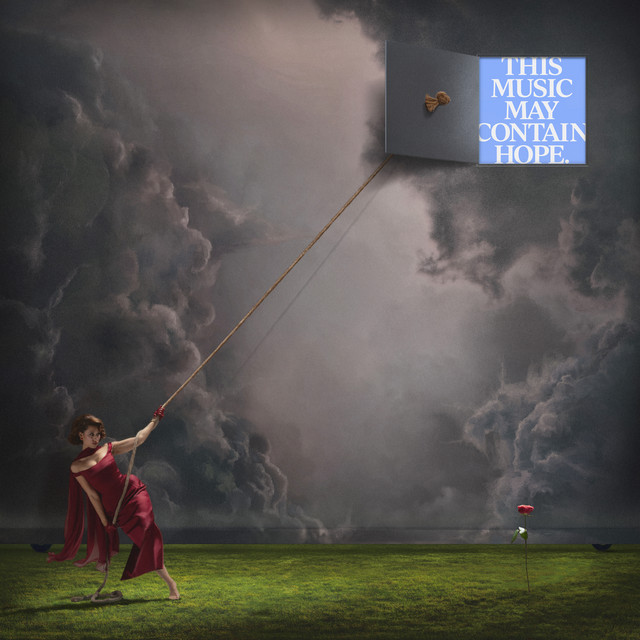
THIS MUSIC MAY CONTAIN HOPE. – RAYE
RAYE | Human Re Sources | 27 March 2026 | 7/10
There’s a version of this album that’s one of the best British records in years. It’s in here somewhere, buried beneath the seasonal divisions and the Hans Zimmer collaboration and the seventeen tracks that collectively demand seventy minutes of your undivided attention. RAYE has always been more talented than the industry let her demonstrate — her debut, My 21st Century Blues, was a statement of arrival that felt genuinely overdue — and THIS MUSIC MAY CONTAIN HOPE. is, if nothing else, proof that she has absolutely no intention of making herself easier to consume. Which we respect enormously. We just wish the editing matched the ambition.
Let’s be clear about what she gets right, because there’s a lot of it. “Click Clack Symphony,” featuring Hans Zimmer, is absurd on paper and somehow completely convincing in practice — a genuinely cinematic swell of strings and percussion that frames RAYE’s voice not as an instrument to be admired but as something elemental, something that needs scoring around rather than produced over. It’s the kind of track that makes you sit up straighter. Similarly, “WHERE IS MY HUSBAND!” — all-caps, exclamation mark, entirely warranted — is the album’s most immediate moment, a bolting, furious piece of pop-soul that demonstrates exactly what RAYE can do when she locks onto a groove and refuses to let go.
“I’ve been loyal, I’ve been patient, I’ve been quiet for too long”
That line, delivered mid-”WHERE IS MY HUSBAND!” with the particular kind of controlled fury that only comes from someone who’s genuinely lived it, is the album’s thesis statement more than any of the interludes or seasonal chapter breaks manage to be. It’s specificity doing the work that concept usually fails to do.
The centrepiece of the album’s second act, “I Know You’re Hurting,” clocks in at six minutes and earns almost all of them. It’s the kind of slow-building track that would feel self-indulgent from a lesser vocalist — a cathedral-sized production that asks you to sit in someone else’s pain without flinching. RAYE doesn’t let you off the hook. There’s a moment around the four-minute mark where the arrangement strips back and it’s essentially just her voice in the room with you, and it’s quietly devastating. The Variety assessment that she “purrs and belts and soars” isn’t hyperbole; it’s description.
“Goodbye Henry,” featuring Al Green, is a different kind of triumph — looser, warmer, the most spiritually generous track on the record. The pairing is either insane or obvious depending on your frame of reference, and we’d argue it’s both simultaneously. Green doesn’t overshadow; he blesses the thing, and it lands like a letter of recommendation from someone you’ve always wanted to impress.
But the seasonal structure that RAYE has built the album around, while conceptually interesting, creates as many problems as it solves. The transitions between sections occasionally feel like interruptions rather than developments. “Nightingale Lane” and “Skin & Bones” are both decent tracks that struggle to locate themselves within the album’s emotional geography — they’re not bad, they’re just slightly stranded, arriving after the “I Know You’re Hurting” peak and before the closing run without quite knowing what they’re supposed to be doing. The album’s second half, from “Life Boat” onwards, is where the structural ambition starts to feel like a liability.
“Joy,” featuring RAYE’s sisters Amma and Absolutely, is exactly what it sounds like — earnest, warm, genuinely lovely — but it arrives at a point where the album has already asked a great deal of your emotional bandwidth, and it can feel more like obligation than revelation. It’s not unlike the closing stretch of Messy by Olivia Dean in that regard — an artist clearly invested in wrapping things up with hope rather than complication, which is admirable, but which occasionally strains credibility after everything that’s preceded it.
There’s a reading of this album in which the maximalism is entirely the point — RAYE as someone who spent years being told to be smaller, now absolutely refusing. We have sympathy for that reading. The Northern Transmissions take that she should have just written a musical is glib, but it’s not entirely without logic; there are moments where the album is clearly straining against its own format, wanting to be staged, wanting bodies in seats and lights changing overhead. We’d genuinely be curious to see what she’d do with the Royal Albert Hall.
What THIS MUSIC MAY CONTAIN HOPE. does is demonstrate that RAYE is operating at a level where her worst instincts and her best instincts are roughly the same size. She’s ambitious enough to attempt an album structured around the seasons with a Hans Zimmer feature and a late-game Al Green duet; she’s also ambitious enough that the sprawl occasionally overwhelms the substance. The great tracks here — and “WHERE IS MY HUSBAND!,” “Click Clack Symphony,” and “I Know You’re Hurting” are genuinely great — are worth the cost of entry. The album around them is a brilliant rough cut of something that could have been extraordinary with a little less of everything.
Hope, it turns out, is not the same thing as restraint — and for RAYE, that gap is both the album’s greatest strength and the thing that keeps it from being essential.